
Database schema diagrams
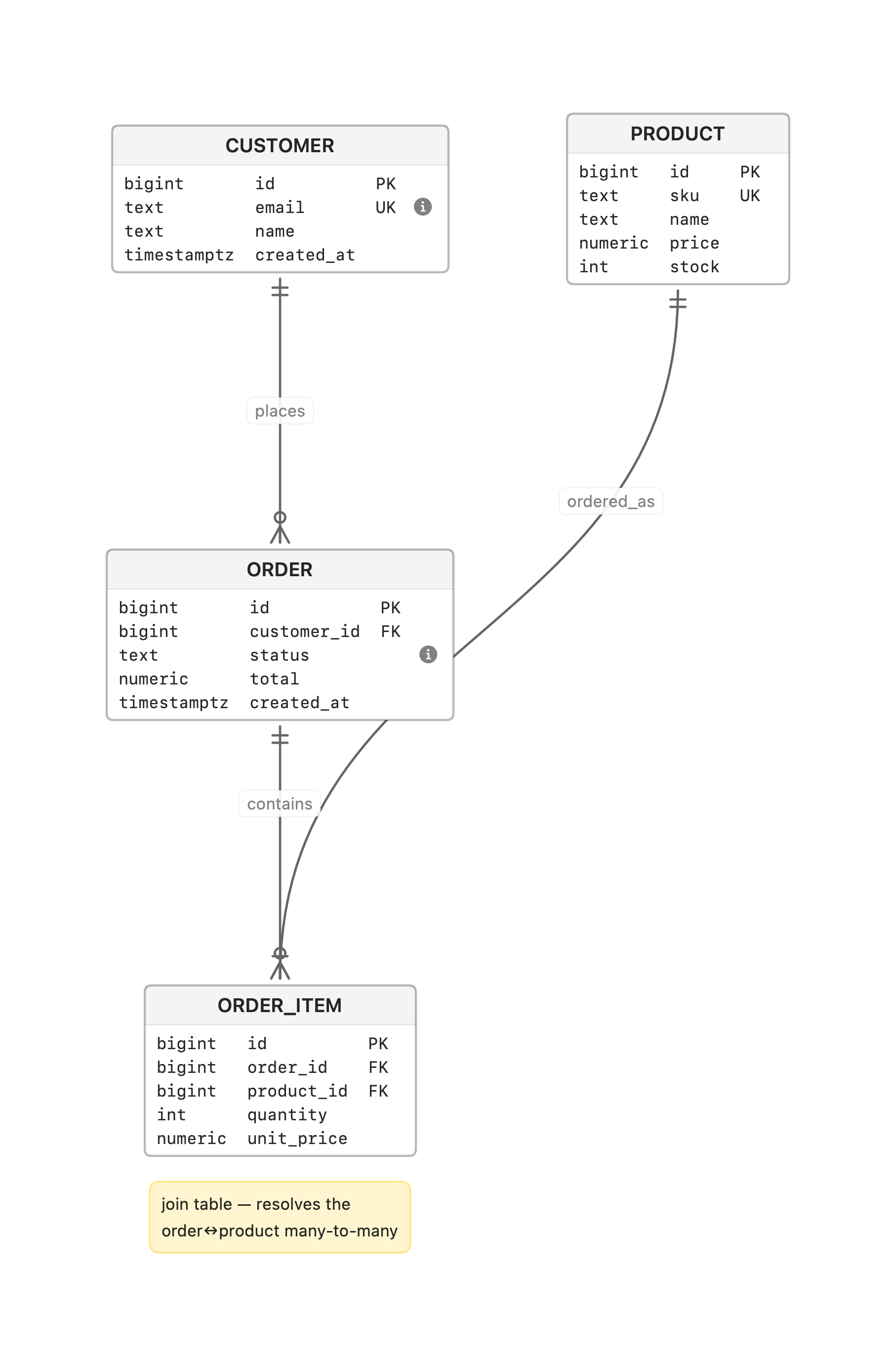
Best for “what does the data look like?” — a relational schema drawn as an entity-relationship
diagram. It’s Mermaid’s erDiagram: a customer places orders; each order contains
order_items, and every line item points at a product. ORDER_ITEM is the join table that
resolves the many-to-many between orders and products.
erDiagram  CUSTOMER ||--o{ ORDER : places  ORDER ||--|{ ORDER_ITEM : contains  PRODUCT ||--o{ ORDER_ITEM : ordered_as
  CUSTOMER {    bigint id PK    text email UK "lowercased on write"    text name    timestamptz created_at  }  ORDER {    bigint id PK    bigint customer_id FK    text status "pending | paid | shipped | cancelled"    numeric total    timestamptz created_at  }  PRODUCT {    bigint id PK    text sku UK    text name    numeric price    int stock  }  ORDER_ITEM {    bigint id PK    bigint order_id FK    bigint product_id FK    int quantity    numeric unit_price  }
The first keyword is erDiagram.
- Relationships read
A <card>--<card> B : label— the crow’s-foot cardinality markers (||one,o{zero-or-many,|{one-or-many) sit at each end, and the label names the relationship. - Each
ENTITY { … }block lists columns astype name [key]. Column tags render as badges —PK,FK,UK— and a quoted string after a column becomes an info note.
This is the same web-shop domain modelled as an object graph and a lifecycle on the
Class & State page. To tint a table, use a
vizzy-fence style override — Mermaid’s own style/classDef
only apply inside flowcharts.